Friday, November 22, 2013

Perfumer or Perfumista


(Posted 11-22-13 on Facebook Fragrance Friends, a forum on Facebook dedicated to fragrance enthusiasts, as part of a series coordinated by owner Charlotte Scheuer to highlight perfumers and bloggers in the group.)


Perfumer or perfumista? That is the question.

I love perfume: odors that are composed by nature or the human hand.
  
I love smelling and am grateful for having arrived at a fully conscious awareness of my nose as the sense that guides my life.

I love to create.  With my hands, my head, my heart and my nose.  As a trained architect I transferred the desire to create from the visible realm to the invisible.  A perfume is a construct nonetheless.

Creating perfume is the time I set aside to explore the olfactory world and to be alone.  As a perfumer I enjoy freedoms I could never experience as an architect.  A perfume does not have to respect laws of gravity, or many other laws, for that matter.  
It can be pure expression.  
Pure poetry.  
Pure art.  
Pure.

I wear perfume.  A lot.  All the time.  If I’m not enjoying the work of others, I’m evaluating my own, studying historical precedents (I have a vintage perfume collection mainly for this purpose) or essences in my organ.  Because I use my body to help me with my work, I eschew scented detergents, skincare or anything that could interfere with what I am wearing.

Creating perfume is at once a guilty pleasure and a profound struggle.  I can’t believe I get to work with such immediate beauty and then I embark on a journey into the unknown filled with unexpected twists and turns, frustrating attempts and unresolved solutions. Discipline helps focus the exploration and imagination allows me to recombine accords so I can resolve a concept.  I know a perfume is completed when it is seamless. 

I never approach the design of a perfume from the same perspective.  Sometimes I build from the ground up, at times from the top down, or laterally, diagonally, spiraling . . . I like to experiment.  I imagine smells first and sketch out initial concepts.  I then blend accords that explore different facets.  Gradually refining my direction, clarifying my intention.  Sometimes an accord blended years ago will fall into place.  I’ve learned to expect and welcome the unexpected.

I’m constantly thinking about my work.  While driving my girls to school, brushing my teeth or cooking a meal (seldom following a recipe, relying instead on my nose).  I’m alway engaged and never bored.  I have sketchbooks everywhere so I can jot down notes; while stopped at a red light, waiting outside a classroom or in the kitchen.  Some of these notes get expanded into articles I post on my Architecture of Perfume blog and others are developed into projects.  Unconscious dreamwork is also part of my process, so I always apply a scent before going to sleep.  Any excuse, right?! 

About 10 years ago I started with just a few essences and gradually built my library into the 300+ organ I have today.  I purchased as many samples as I could in order to study, memorize, and blend in dilution.  I’ve stuck with naturals because I feel an intense connection to them. I work with plants, extracting them for my skincare and my perfumes, so it stands to reason that I would want to combine their essences to make perfume. They are damned hard to work with, but ever so gratifying when they finally decide to play nice.  

I’ve considered expanding into synthetically derived aroma chemicals, if only to educate my nose and add dimension to my knowledge. But I’m still on the fence about using them, as I tend to work with materials I love intuitively.  Synthetics are abstract and can be so persistent in a blend, but I can also see how they can lend nuance or clarify structure.  The Institute for Art and Olfaction hosts monthly open blending nights, so that might be a way for me to explore synthetics while supporting my community.
Speaking of which, community is vital to my work.  Not only have I made amazing friends this past year, but I’ve seen how important it is to support others, which is why I created FRAGments, an indie/artisan perfume event that brings together perfumers, perfume lovers and perfume.  I also frequent Scent Bar, often marvelling at how fragrance allows total strangers the freedom to smell each other, taboo in any other context!

The online community has been very rewarding.  Not only do I vicariously experience every SOTD in my inbox, but I scroll through threads, participating whenever I can.  I subscribe to a gazillion blogs, read any book that comes my way and generally immerse myself as much as possible.  It never feels too much or burdensome.  And there’s always room for another viewpoint, another insight, another perfume.

Saturday, August 17, 2013

Persia, Poetry and Perfume


Although 34 years have passed, the roses in this garden still bloom.
Read the article on Cafleurebon by clicking the link below.

Persia, Poetry and Perfume: My Journey Home

Wednesday, July 17, 2013

FRAGments in LA: Crucible of Ideas


Last September, Parfums Lalun was launched at the LA Artisan Fragrance Salon, an event that gave me the opportunity to present my work to the public.  After years of work and study in my “ivory tower” I embraced the opportunity to meet other perfumers and members of the perfume community.  Upon returning home from my second Salon in San Francisco (end of March ’13), I realized there was a healthy audience of sophisticated enthusiasts, but no venue that lived up to the quality of work I had experienced at the two Salons.  Since artisan/indie perfumes have such limited distribution, I felt an event that highlighted the work as art was necessary.  The idea for FRAGments was born intuitively and quickly materialized within two months of its inception.  

An amalgam of “fragrance” (frag is also slang for fragrance) and “movement”, FRAGments was conceived as a way to present the work of emerging and independent artists using scent as their medium.  It also represented a cultural shift towards a new awareness of perfume-as-art and projects related to olfaction.  As a metaphor, it evoked the image of capillaries moving away from arteries, of individuals fragmenting from the mainstream.  

The first FRAGments was intended to be an introduction to the perfume-as-art genre.  The perfumers selected represented a cross-section of work by established perfumers as well as those just launching.  Curated as a collective, each perfume artist was asked to present up to five items from their collection.  (Future events will include voices of perfumers who have not yet launched, but who have an interesting body of work.) 
FRAGments display unit mockup

Such an event would also be a form of resistance against the connection between perfumery and commerce where perfume collections are referred to as “brands” instead of “art”.  Unlike the typical trade show, this event would spotlight the collective artistry of the perfumes rather than brand identity.  For this reason, display units were designed to house each perfumer’s work.  A uniform module conceived as a fragment of a whole, a simple “C” type extrusion with a top shelf for testers, a vertical surface for an image and a bottom shelf to display bottles and packaging.  The units could be positioned in a variety of ways and would read as a common denominator within any given context.  It was important to fabricate these units by hand so that the overall philosophy of the event would remain intact.  It was also important for the event to be independently produced, reflecting the voices of the participants.
Santa Monica Blvd 1950-2011, courtesy urbandiachrony.wordpress.com

It’s probably no coincidence the context for FRAGments turned out to be Los Angeles, a scrappy city that sprawls into a scruffy landscape concealing a complex and quixotic nature.  It may be the end of the line for some but an open road for others, especially artists.  Unlike Paris or NY, Los Angeles is not a commercial hub for perfume, but rather a crucible of ideas.  Evidence to support this includes the recently formed IAO (Institute for Art and Olfaction) whose mission it is to create “an environment that encourages new exploration of the olfactive arts”. Saskia Wilson-Brown, IAO’s founder, recognized this potential and graciously accepted my request to moderate a discussion with the perfumers, the most controversial topic being the definition of independent vs. artisan perfumer . . . to be continued . . . 
MorYork Gallery

MorYork Gallery was chosen as the event location because Clare Graham’s work visually embodied the spirit of the diverse group of perfumers selected, who create unique, multi-faceted and experimental olfactory art.  I approached Clare with the idea of a perfume-as-art event and he graciously offered his space. In doing so, he not only invited us to inhabit his gallery and intertwine our work with his, but helped validate our effort through his support. 
Roxana Villa
Persephnie Lea

Scented Sculpture
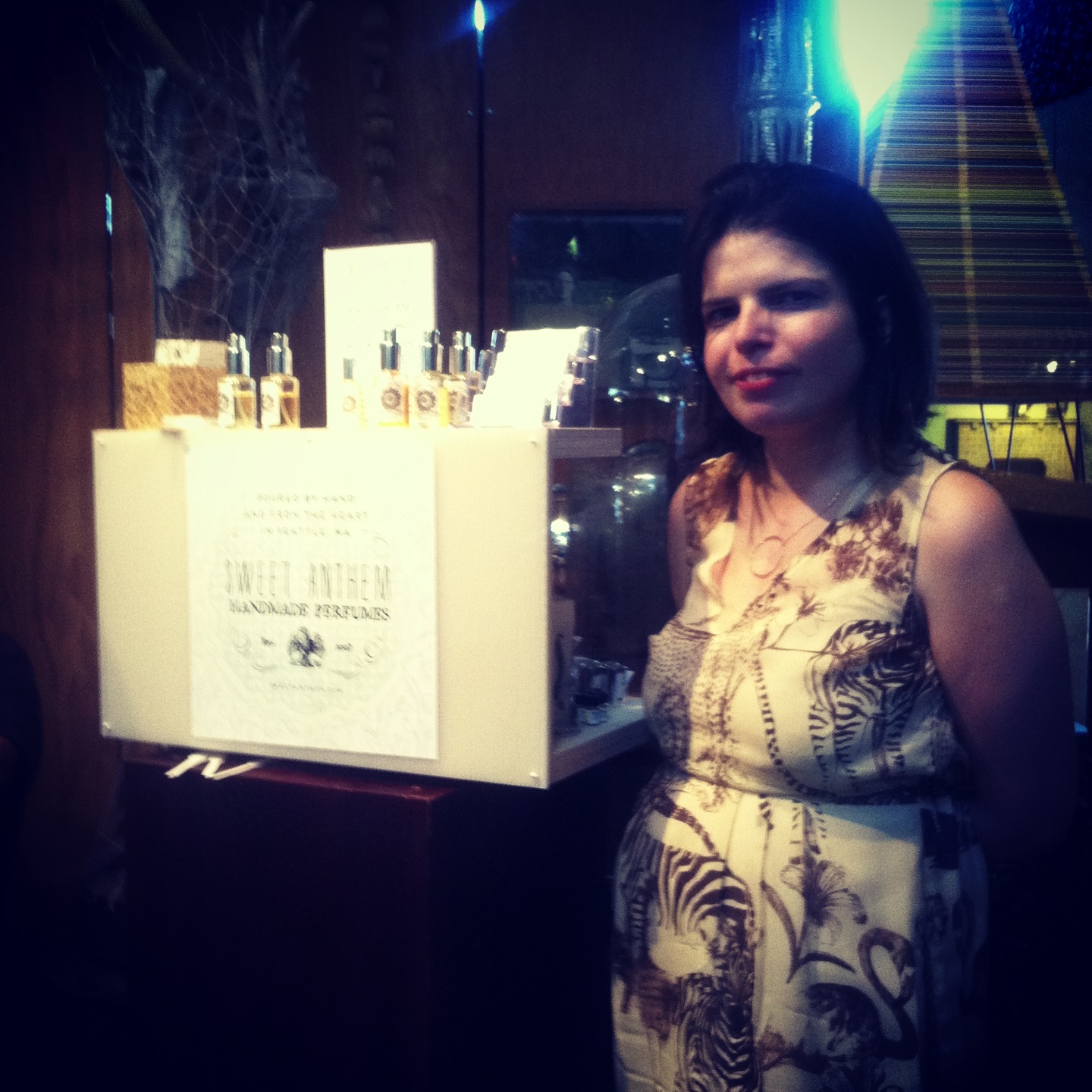
The perfumers selected for the event were mostly from the West Coast: Seattle, San Francisco and Los Angeles.  Local perfumers included Roxana Villa, Persephenie Lea, Sherri Sebastian and myself who maintain a strict handmade ethos in our search for an authentic voice. Roxana draws inspiration from the arts and crafts movement as well as from the natural beauty of her surroundings and her illustration background to create a series of botanical gems.  Persephenie has an established line of fragrance and skincare but chose to present an experimental art piece related to her work as a perfumer: a beeswax painting infused with jatamansi (spikenard) paired with a handmade box of perfume curios.  I presented a sculpture made with felted marino wool that invited one to touch and sniff (wool attracts odor molecules).  Sherri, a professional perfumer, took an innovative direction with her line of gel-based natural fragrances.
Sherri Sebastian
Zelda by Shelley Waddington
Moving up the coast to San Francisco, Yosh Han, Mik Moi, Lisa Fong, Heather Kauffman, Laurie Stern and Shelley Waddington presented their eclectic offerings. The California coast is never far from Shelley’s lush perfume interpretations and Zelda (which she launched that day) was no exception. Laurie’s intricate perfumes captured the charm of the Victorian language of flowers, but from a contemporary point of view.  Lisa’s slow blends were intellectual and visceral; I loved her description of creating natural perfumes to be like “carving marble”.   Heather and Mik recently launched their lines and both embraced a modern aesthetic; with Nouvelle Vague references by Heather and a socially conscious approach by Mik.  Yosh unveiled her new line of fragrances called TimeLine.  As I sampled them I let out an involuntary grunt only to find out the name of the fragrance was “Caveman”. I then sniffed my way through the history of humanity which ended with Dystopia in the year 77778.
Laurie Stern

Lisa Fong
Heather Kauffman

Mik Moi

Yosh Hann


David Falsberg
Further north the Seattle contingent included David Falsberg, Christi Meshell, Nikki Sherritt-Smith, and Meredith Smith who exhibited fiercely individual expressions. David’s hyper-real blends included Skin Graft, a perfume about his experience with Steven Johnson’s syndrome.  With it’s antiseptic Band Aid accord it served as a reminder that life encompasses everything from dis-ease to the beauty of survival.  Christi’s naturals simply pumped up the jam, they were so dynamic and vivacious.  The “Rebel” in Nikki’s botanical perfume line name belied her approach to perfumery; compositions driven by her own artistic vision.  Meredith gave everyone a taste of her indie fragrances some of which are inspired by popular rock’n’roll themes.  It should be noted that she also owns a shop that carries the work of other artisan perfumers!
Christi Meshell


Nikki Sherritt-Smith

Meredith Smith


JK DeLapp
Ayala Moriel
That leaves us with JK DeLapp (San Diego, CA), Ayala Moriel (Vancouver, BC), Amanda Feeley (Ames, IA) and Dawn Spencer-Hurwitz (Denver, CO).  JK, a Chinese medicine practitioner, launched his line of rich natural oil blends inspired by the 9,000 year old tradition of his profession.  He also shared some rare examples of high grade aloeswood from his collection.  Ayala had to jump through some international hoops so that we could experience her emotionally charged perfumes which brought forth tears, smiles and memories.  Amanda, who composes “music for the nose” included her “Lumberjack Man”, a fragrance that added levity to the day.  Dawn introduced us to her painterly method of layering scents with a subtle hand, her five perfumes being just the tip of the iceberg from her molten talent.
Amanda Feeley and the Lumberjack Man


Dawn Spenser Hurwitz


FRAGments was a great opportunity to build community and create a recognizable forum for people to meet and exchange ideas in person.  This was probably the most important aspect for me since it gave me the chance to meet and work with others.  It’s important to acknowledge other community builders who inspired me like Yosh Han who instigated the Artisan Fragrance Salon series and created a dynamic Facebook community called Aroma Village, Ayala Moriel who put together an amazing tea party the day before the San Francisco Salon and Persephenie Lea who hosted a number of meet-the-perfumer events I attended several years ago in her Edinburgh Street studio in Los Angeles.  It was wonderful to have their presence and support at FRAGments.
Maggie at Persephenie's event featuring Laurie Stern

Pantheon
Finally, pairing the event with the summer solstice allowed the longest day of the year to be celebrated in a space where the changing light could be enjoyed while socializing and sampling fragrances in a relaxed atmosphere.  At times reminiscent of the Pantheon, shafts of light would pierce the darkness and Clare’s artwork would form a rich tableau vivant of illuminated artifacts framing the perfumers.  It was also quite warm in the space, a reminder of what summer feels like with just enough volatility for the perfumes to bloom.  With so much inspiring work it was hard to forget the olfactory realm is our last frontier.  Historically under-appreciated and underutilized, we are finally witnessing a surge of interest in this area.  This has resulted in record breaking perfume launches, scientific studies and artistic explorations.  The good news is:  this is just the beginning and LA is positioned to be its creative epicenter.

“You know the day destroys the night
Night divides the day
break on through to the other side.”  The Doors


Sunday, July 29, 2012

Beyond the Veil


Vintage Chanel Flacon


When one thinks of perfume, instinctively commercial brands come to mind.  However, the perfume world has changed dramatically the last few years facilitated by social media sites that have made it possible for enthusiasts to exchange ideas directly and create virtual communities.  It is here that one can gain exposure to other types of perfumes such as niche, natural, experimental, conceptual, vintage or art fragrances.  It is here that one can meet and converse not only with fellow perfumistas, but with bloggers, critics, writers, sellers, buyers, aromatic producers, manufacturers, historians, curators and even perfumers.  Because of this connectivity it is now possible to stay on top of things regardless of where one lives.  The fragrance world is no longer a centralized hegemony, but an individualized paradigm within the context of a raw democracy.
Image courtesy Sheila Eggenberger
It was through this venue that I was able to meet Sheila Eggenberger, read her Quantum Demonology novel and take part in the DevilScent project as a blogger.  It was this context where Sheila met Ellen Covey, a perfumer (owner of Olympic Orchards) and partner in crime.  Since Ellen started the DevilScent project with Sheila her Dev variations are not just interpretations of the Devil’s fragrance but four archetypal aspects of that entity.  Together they are the perfume equivalent of the character Sheila Eggenberger created.  Dark, bitter, rich, spicy, earthy, fiery and cognac smooth. They can be experienced as stand alone fragrances, form a transition from one state to another or be layered for a devilish rush. 
Papier Mache and Lacquer Bodhidharma
Dev 1 and 4, Alpha and Omega, beginning and end share a note that I can only describe as lacquer.  An opulent dark lacquer adding luster to the surface of rich wood and fine art.  From the moment I smelled these perfumes I had a flashback to when I would accompany my parents to the bazaar in Tehran where they would take their antique furniture to be refinished.  
"Bazaar" Image Courtesy Hamzeh Karbasi

The workshop was medieval at best, a dark, crepuscular space with furniture piled haphazardly, cans of lacquer and shellac, waxes, oils and stained rags strewn about.  There was a haze of wood dust and cigarette smoke that never seemed to settle down.  The walls were damp with patches of swelling plaster and yellowed paint.  A skylight punctuated the end of the space where a crouched figure worked, the odor of his sweat a reminder of the heat outside.  Mingled together was the smell of wood; fresh, aromatic and exotic.  
Giant Arborvitae Image Courtesy NW Aromatics
But Dev 1 and 4 also reminded me of something else which I finally identified when I recently pulled out samples of Nootka and Giant Arborvitae I purchased from a Canadian company that produces these oils sustainably from leftover sawdust.  It is rare to find an essential oil that has longevity, lift and sillage, but Giant Arborvitae is just such a gem.  True to its name though, it is a giant that can squelch practically everything in its path and is very difficult to tame.  The beauty of Dev 1 and 4 are that Ellen Covey has not tried to tame the giant, recognizing instead, the power of this aromatic and has paired it with other strong notes to create an untamed fragrance that unleashes memory and desire. 
Image Courtesy thelooksee.com
Giant Arborvitae (Thuja plicata) is a wild and ancient tree, a cypress native to North America and intrinsic to the lives of the indigenous people of the Pacific Northwest.  All parts of the tree were used to create canoes, housing, clothing, baskets, fishing poles, utensils and totem poles.  Arborvitae means “tree of life” and specimens can live for hundreds of years.  Using the oil from this tree can certainly invoke its spirit (benevolent or mischievous) which comes to life on the skin.
Image Courtesy "lk"
Dev 2 and 3 are bridge fragrances that swing in different directions.  Dev 2 has a sweet sexiness in its depth.  But Dev 3 is crazy spicy and takes me down yet another memory lane to the same bazaar where my mother would buy her medicinal herbs and culinary spices.  This was a very different space, that of a peaceful and somewhat rotund Hajji who sat behind his counter surrounded by jars, amphorae and baskets of herbs.  He would dutifully mete out the contents of a vessel onto a scale using brass weights for balance and then pack everything in brown paper bags and calculate the cost with a well-worn abacus.  
I asked my mother to try Dev 3 and tell me what it brought to mind.  She immediately remembered the spice shop and its smells as well as the woody lacquer note.  How Ellen could have created fragrances that bring to mind the same distant memories for my mother and myself is amazing.  Such is the skill of a talented perfumer who can harness the mystery of fragrance.  
Prepared Piano
Ellen Covey’s Dev quartet are not easy fragrances with mass appeal like most commercial perfumes marketed today (witness Justin Bieber). The Dev series are conceptual explorations along the lines of a John Cage composition for the prepared piano.  Working with a difficult aromatic is analogous to rigging up an instrument so that the sounds produced are no longer familiar but new and evocative.  Once the ear grows accustomed to this new terrain, it’s hard to go back to the familiar, classically composed instrument.  Similarly, once the nose grows accustomed to unconventional scents, it’s hard to wear a classically composed fragrance the same way.  Conceptual explorations cause a shift to occur, a change of perspective, a door to open onto an unknown space.  
Marcel Duchamp "door"
Conceptual perfumery can hardly be considered a fragrance category (yet), let alone one intended for commercial success, there are so few perfumers who have gone out on that limb, but it is an exciting area of exploration that has the potential to push the boundaries of the medium.  Thanks to the online community, there also seems to be an interest in perfumes that buck convention.  Hopefully, the day will come when our collective perfume horizons will be expanded beyond the veil that stands between fragrance and art.
Elenore Abbott

Saturday, July 21, 2012

Fragrance Appreciation


More than the casual spritz, I argue that fragrance appreciation is something we can all enjoy!  Read about it on Cafleurbon:

http://www.cafleurbon.com/more-than-a-casual-spritz-fragrance-appreciation-la-lune-de-miel-perfume-draw/

Sunday, July 15, 2012

les Maitresses Parfumeuses


Photo courtesy of
hydeinblackroom.blogspot.com

What makes the Faustian tale so compelling?  Is it the promise of worldliness?  Getting what we want?  The thrill of flirting with danger?  Perhaps the first tale of its kind was the Adam and Eve story, where they tasted of the tree of knowledge and their eyes were opened.  There’s always a price to pay when dealing with the devil and theirs was being cast out of Eden and thrust into the world.  


The memory of their original home and past innocence attained mythic proportions and as a result God, their creator, became the gatekeeper of their past.  Somebody else had to step up to the plate and provide the tools for their survival and success in the wilderness.  That was the Devil who offered ambition and drive (along with seven other deadly sins) so that future generations could enjoy the fruits of culture and sophistication.

Dev and Lil perfumes
photo courtesy of Sheila Eggenberger
Alexis Karl and Maria McElroy of Cherry Bomb Killer Perfume, have delved deep into the myth and mystique of the devil.  Inspired by the characters in Sheila Eggenberger’s Quantum Demonology novel and their own dark-themed work, these mistresses of the subconscious have collaborated on the creation of two fragrances for the Devilscent project: Dev and Lil.  Although named after the Devil and his wife Lilith, these perfumes also exemplify Adam and Eve after their expulsion from paradise. The ousted couple, residing now in New York City (like their mistress perfumers), prefer the shelter of the night to the shining light of day, and never leave their apartment without perfume.

Photo courtesy of
honestcooking.com
Smoldering caramel, burnt sugar, molasses and maple, Dev is the ultimate gourmand fragrance because it conveys the original meaning of the French term: that of gluttony.  Catching a whiff is not enough.  One needs draughts of the stuff, inhaling deeply and coming back for more.  It’s thick enough to eat and can cause Americans to spontaneously erupt in French “c’est si bon!” (thanks Yoplait).  It’s a decadent olfactory dessert and if worn on the right man could make a woman skip that course and head straight for the sheets.  This perfume would have made Adam’s first wife Lilith submit to his demands so that God wouldn’t have to fashion another mate from his rib (ouch!).  It is domination in a “Venus in Furs” kind of way, where pleasure and pain are exchanged freely.


Lil, on the other hand, is “Femme Fatale”, sung to perfection by Nico with her throaty voice recalling Edie Sedgewick, muse to Andy Warhol at the Factory.  One tragic superstar glamazon singing about another.  However, beneath her charming gamine exterior and celebutante background Edie, like Lil and even Nico is “from the street, She’s just a little tease (She’s a femme fatale), See the way she walks, Hear the way she talks, She’s gonna play you for a fool yes it’s true”.  Alexis and Maria’s creations are avant garde perfume covers of these two songs that live side-by-side on the Velvet Underground & Nico album.  They are rock perfumes that deal with the dark veins running beneath the surface of sweetness and beauty. 

Image courtesy of Alexis Karl
There is another musical connection through Alexis Karl who, in addition to being a talented perfumer, is a trained opera singer and visual artist.  She performs her musical compositions with her band “Ondyne’s Demise”, her voice capturing the gloaming dreamscape of the subconscious and transporting us through the gothic atmosphere of danger and mystery.  While the Velvet Underground lyrics conjure up archetypal anima/animus images of Dev and Lil, Adam and Eve, Andy and Edie, Lou and Nico . . . the smoky sounds of Ondine’s Demise provide the backdrop for all of these Faustian arrangements.  Is this particular melding of perfume and music inspired by the devil himself?  Perhaps, but I doubt these Maitresses Parfumeuses will ever divulge their secrets!


Monday, May 7, 2012

Amanda Feeley Devil #1, #2 and #3 Desk Crit:


(I am reviewing individual perfume modifications or sketches as "desk crits", based on my experience of how architectural projects are critiqued during the design phase.  When all of the perfumes are in, I will do a "final review", again modeled on the way architectural projects are reviewed as a whole.)
There is something “Puck-ish” about the *fragrances Amanda Feeley has created for the DevilScent project.  Puck is the mischievous trickster and nature sprite who appears when you speak of the Devil.  He’s also known as Robin Goodfellow or Hobgoblin (derived from Robin) and other variations.  As a literary character he makes his appearance in Faust’s “A Walpurgisnacht Traum” but is best known for his role in Shakespeare’s “A Midsummer Night’s Dream”.
Puck seems close to Amanda’s heart, imbuing her work with knavish delight and whimsy.  After all, it was Ms. Feeley who organized, or should I say, orchestrated last summer’s “A Midsummer-Night’s Dream”, an ambitious project involving 16 perfumers and 11 bloggers that owed as much to Mendelssohn’s symphony as it did to the play.  Ms. Feeley created two perfumes for that event:  Pixie Dust and Bottom’s Dream, the former smelling of the forest, the latter of peach (“Do I dare eat a peach” The Love Song of J. Alfred Prufrock).  
Her perfume modifications for the Devilscent project are three interpretations of a Puck-like devil who inhabits the forest.  All three versions share the same labdanum bed to a varying degree. Devil #1 has a fir balsam note layered onto labdanum that’s paired with a vaguely minty top.  Wormwood (Artemisia absinthium) comes to mind which wouldn’t surprise me since Ms. Feeley’s handle online is the "Absinthe Dragonfly".  All of the plants in the Artemisia family dwell in the wild and pay heed only to their hunter goddess, Artemis.  Devil #3, on the other hand digs underground and is noticeably earthier, muskier, possibly due to a liberal addition of angelica root, perhaps intended as a symbol for a fallen angel? 
While Devil #1 and #3 share similarities and arrived on my doorstep in the same bag, Devil #2 was alone in his own bag and when I smelled him, I could understand why.  It was clear this little guy was not willing to share the stage with the others.  He had also sneaked out of the vial and had smeared the label.  Ahhh, calamus root (Acorus calamus).  But why this botanical?  I went back and discovered that the rhizome of this grass (also known as sweet flag or sweet grass) was thought to be an aphrodisiac and was possibly one of the ingredients used to make absinthe (the green fairy again).  To further support the aphrodisiac claim given to calamus, it appears as though Walt Whitman added a section to the third edition of his “Leaves of Grass” calling it “Calamus” where references to the plant were symbols of love and lust, the Devil’s calling card.  
The etymology of calamus reveals that it comes from the Sanskrit word “kalama” which in Farsi (Indo-European language) has two meanings.  It can mean either word (kalameh) or pen (qalam) pronounced with the gutteral qu’ain and related to the reed pens used in calligraphy that were made from a special hollow grass (probably calamus).  Of course, the reed is also used for certain wind instruments, like the oboe or pan-flute that would have been played by our mischievous Puck as he would lead folks astray in his woodland domain. 
While Devil#1 and #3 are interesting compositions, #2 captures the trickster embodied by Sheila Eggenberger's Dev, but more importantly, it lies at the heart of Amanda’s quixotic work.  This is the scent I imagine Stanley Tucci’s wry and satirical Puck would have, a trickster after my own (naturally) perfumed heart! 


*Ms. Feeley works only with natural and botanical essences.

Wednesday, May 2, 2012

Neil Morris "Dev#2" Desk Crit: Semiology of Scent


(I am reviewing individual perfume modifications or sketches as "desk crits", based on my experience of how architectural projects are critiqued during the design phase.  When all of the perfumes are in, I will do a "final review", again modeled on the way architectural projects are reviewed as a whole.)
My initial reaction to Neil Morris’ Dev#2 was:  “Well, knock me down with a feather . . . preferably one that comes from a fallen angel . . . and reel me in with sexy cumin”.  Mind you, this is not Le Labo’s Rose 31 version of cumin, but a gorgeously bitter and fermented concoction with notes of wine soaked raisin/date/nut meat like the haroseth prepared for a Persian seder with smokey pepper thrown in.  
To my nose Neil’s creation has the same elements as *Kyphi, the sacred Egyptian incense made with wine, dates and raisins which most likely contained labdanum, another mainstay of the ancient world.  Like an artifact from antiquity, Neil’s Dev#2 has an abstract quality. It is, indeed, an incense type fragrance, but deconstructed.  One that can be reduced to the abstract interplay of its two main components, cumin and cistus, notes that have been structured in a way that defy a homogeneous cultural reading.  Cumin and cistus act as signifiers that identify a heterogeneous concept of the signified (incense).
Deconstruction in architecture, unlike Jacques Derrida’s practice of analyzing texts to reveal ambiguities of intention, became a means of overlaying a (sometimes arbitrary) system of generating form which would not be referable to any cultural or historical language.  It attempted to create an anti-symbolic method of designing buildings, but was ultimately flawed and contradictory because nothing can ever be reduced to a non-symbolic form so as to be read and understood by everyone.  There’s always a layer of cultural meaning that seeps in to muddy the waters.  And that muddiness and ambiguity is what becomes interesting anyway.  
Deconstruction in perfumery however, could be more fruitful and less polemic, both in terms of creation and analysis.  I sense that Neil Morris is already working within the parameters of ambiguity, especially through his “Vault” line (http://www.neilmorrisfragrances.com/vault.html), if Dev#2 is any indication.  As an independent perfumer, he is free to explore concepts and fragrance combinations that commercial perfumers could never touch.  The fragrances he offers are part of an oeuvre, or life work that describe his trajectory of exploration.  I also sense that he is a minimalist, preferring to pare down his perfumes while allowing them some muddiness.  Dev#2 is wearable but certainly not conventional.  I would contend that Neil Morris has nailed it with this modification he sent me as his interpretation of the devil’s scent in Sheila Eggenberger’s novel Quantum Demonology.


*I have a theory that the haroseth prepared during Passover is a Jewish interpretation of kyphi and may have initially been an incense which was eventually transformed into one of the edible, symbolic elements of the seder table.

Image:  Red Bird of Paradise Feather from the Institute of Zoology and Zoological Museum, University of Hamburg

Monday, April 16, 2012

She Shoulda Said "NO"!

Sheila Eggenberger’s debut novel, Quantum Demonology is a raucous romp through the world of supernatural forces that have attempted to claim our measly planet since time immemorial. Woven through her tale are invisible strands of perfume and metal music, forming a unique backdrop of sensuality and divine darkness. Part personal theology, part dialectical critique, part mythological collage, part “anarcha feminist” commentary, part metaphor for mid life crisis along the lines of Dante’s Divine Comedy, the protagonist in this novel within a novel bares it all: her her body, her soul and her aspirations. No detail is spared and her language seeks to capture the essence of the unknowable.

The novel moves at a filmic pace with quickly changing events, characters and places presented through the lens of a deft cameraman/writer. Not only do we meet the Devil and his angry wife Lillith, but God and his wife, St. Peter, Leviathan, Asmodeus, the Angel of Death and some other world class deities. The human cast includes a best friend, past lovers, frenemies, a psychotic editor and a few select rock stars. Much of the action takes place in the author's home town of Copenhagen, in particular a club called Alcatraz where the protagonist has a cult following for her karaoke performances. Once she accepts the Devil’s Faustian offer, we’re off on whirlwind journeys to hell, heaven and back through the door of a house in Brooklyn. We also get to stay in Room 822 at the Chelsea Hotel, very different from the demonic Room 237 in the Shining . . .

So what do we learn about the Devil? He takes on the human form of a notorious rock star (minus the tats), wears black, hides behind aviator shades and announces his presence through a labdanum rich perfume. As the keeper of negativity he tends to have a bad temper and is prone to bad behavior as well. But there are other aspects to his character that are revealed as the novel progresses which provide insights into the pathos of his situation that only our heroine is able to rectify. The source of his malady is Lilith, his estranged wife and her scheming son Asmodeus. This is not the Midrashic Lilith, Adam’s first wife as presented by Theodore Gaster in his World of Myth class at Barnard College, nor Ashmedai who may have been the source of the Merlin character (the subject of my term paper), but a vengeful harpy surrounded by her Succubi who threaten to unleash hell and devour the world.

Our protagonist is seduced by the devil into saving the world and the instrument of her seduction is his fragrance. Having consciously married a man for his scent and quit a job because of chronic halitosis, this comes as no surprise. So why not save the world? The key ingredient in the Devil’s perfume is labdanum, a note that can be incensy, leathery, animalic, sweet, rich and ambery. It is an ancient aromatic that is still harvested using the traditional method of combing the Cistus creticus or ladaniferous resin from the beards of grazing goats, the symbol of the horny one himself. This method is so old that it was incorporated into Egyptian pharonic iconography. Descendants of Neolithic goat herders, Egyptian pharaohs built their wealth and subsequent power through the labdanum trade and were subsequently shown sporting the crook (symbol of goatherder), flail (actually a ladanesterion used to collect labdanum directly from the plant) and beard (made with goat hair and stuck to the chin using labdanum). The crook, flail and beard were also associated with Osiris, the god of the underworld and the dead, or the Egyptian equivalent of Eggenberger’s “Dev”.

Eggenberger is not only a creative novelist with an amazing command of the English language (like Nabokov), but is known amongst Perfumistas as “Tarleisio”, the author of a perfume blog called “The Alembicated Genie”. There she undertakes the supremely difficult task of writing engaging reviews of perfumes and has a dedicated following that includes yours truly. The origins of The Devilscent Project took place through this venue as a collaboration with the perfumer Ellen Covey of Olympic Orchids. The project has now expanded to become the DevilScent Project where six perfumers have been invited to create perfume interpretations of the novel as their brief. A number of bloggers have also been invited to review these fragrances and The Architecture of Perfume is proud to be part of this interdisciplinary effort.

There have been a number of perfume themed novels recently that have launched dedicated fragrances, but this is different. It is a rare opportunity for dialogue to inform the collaboration between the artists and writers who are working at their own expense. Already perfume modifications are being sent back and forth for evaluation and the results are being recorded through various blog posts. In the coming months I look forward to helping define this interdisciplinary collaboration that is being democratically moderated by Sheila Eggenberger. I always dreamed something like this would happen when I was working as an architect, but now it seems it will unfold for me as a perfumer/critic, and you can be a part of it too. How exciting is that?!


Quantum Demonology, chapters 1-13:

http://quantumdemonology.wordpress.com

Quantum Demonology on Facebook:

http://www.facebook.com/pages/Quantum-Demonology/162894267077952

QD on Twitter:

@quantumdemon

PERFUMERS:

Ellen Covey, Olympic Orchids

http://www.orchidscents.com/Default_v3.aspx

http://perfumenw.blogspot.com (blog)

Kedra Hart, Opus Oils

http://www.opusoils.com

http://scentsofimagination.blogspot.com (blog)

Neil Morris, Neil Morris Fragrances

http://neilmorrisfragrances.com/

Amanda Feeley, Esscentual Alchemy

http://esscentualalchemy.wordpress.com/

Alexis Karl, Scents by Alexis & Cherry Bomb Killer Perfumes:

http://www.cherrybombkillerperfume.com/

Maria McElroy, Aroma M:

http://www.aromam.com

Katlyn Breene, Mermade Magickal Arts:

http://www.mermadearts.com/

(incense)


BLOGGERS:

The Alembicated Genie

http://thealembicatedgenie.com

Chaya Ruchama

http://chayaruchama.com

Indieperfumes

http://indieperfumes.blogspot.com

Perfume Smellin' Things

http://perfumesmellinthings.blogspot.com/

The Perfume Pharmer

www.theperfumepharmer.com

The Perfume Posse

htto://www.perfumeposse.com

This Blog Really Stinks

http://thisblogreallystinksperfume.blogspot.com/

Beauty on the Outside

http://BOTOblog.com

Redolent of Spices

http://redolentofspices.wordpress.com/

Another Perfume Blog

http://anotherperfumeblog.com/

The Muse In Wooden Shoes

http://themuseinwoodenshoes.com/